

What Is an AI Humanizer? Humanizer vs Paraphraser vs Grammar Checker
AI humanizers, paraphrasers, grammar checkers and AI editors change text for different reasons. Here is what each one does, what it risks, and when it is the right tool.
An AI humanizer is a rewriting tool aimed at one problem: text that AI detectors read as machine-generated. It changes the patterns detectors respond to, such as predictable phrasing and uniform rhythm, while trying to keep the meaning intact. A paraphraser restates text in different words for its own sake. A grammar checker fixes errors and leaves your sentences mostly alone. An AI editor or chat assistant writes new text on request.
The four overlap on the surface, since all of them change words, but they have different goals, different failure modes and, for academic work, different disclosure implications.
What an AI humanizer does
Detectors look for statistical regularities. As we explain in how AI detectors work, machine text tends to pick the most probable next word again and again, which produces low perplexity and an even, metronomic rhythm. A humanizer targets those regularities. A good one does it without touching what the sentence claims.
For academic writing, that last condition is the whole job. A humanizer that turns "may be associated with" into "causes", rounds 0.047 to 0.05, or swaps a field term for a casual synonym has damaged the paper even if a detector likes the result. The better designs are selective: they find the sentences that read as AI and leave the rest of the author's text alone. Our post on sentence-level AI detection covers why that matters.
What a paraphraser does
A paraphraser restates a passage in different words. Classic paraphrasing tools work by synonym substitution and clause reordering, often with a dial for how aggressive to be. They are useful for rewording a source you are summarizing, or for seeing alternative phrasings of a sentence you are stuck on.
They were not designed with detectors in mind, and detectors have adapted to them. Turnitin added a separate category in July 2024 for AI-generated text that was likely AI-paraphrased, naming word spinners such as Quillbot as an example, according to its model release notes. Swapping words also tends to leave the underlying structure, and with it much of the detectable signal, in place. We go further into that in why paraphrasing tools fail AI detection, and the research side is in our piece on DIPPER.
What a grammar checker does
A grammar checker corrects spelling, grammar, punctuation and sometimes concision. It changes the fewest words of any tool here. Turnitin's AI writing FAQ says that in its tests on human-written documents, corrections from Grammarly and other grammar-checking tools were in most cases not flagged as AI. It adds an important exception: text from Grammarly's generative features, such as drafting, paraphrasing or summarizing, will likely be flagged.
That line between correcting and generating is the one publishers draw too. Elsevier's generative AI policy for journals says basic checks of grammar, spelling and punctuation do not need a declaration, while substantive changes to sentence structure or organization made by an AI tool should be disclosed.
What an AI editor or assistant does
A chat assistant or AI editor generates text. Ask it to tighten a paragraph and it returns a new paragraph; ask it to draft a discussion and it writes one. It can restructure an argument, change emphasis and introduce claims the author never made. Its output is, by definition, AI-generated text, and it is exactly what detectors are trained on. It is the most powerful of the four tools and the one that most needs disclosure under typical journal policies.
Side by side
| AI humanizer | Paraphraser | Grammar checker | AI editor or assistant | |
|---|---|---|---|---|
| Main goal | Text that reads as human to AI detectors, meaning intact | Different wording for the same content | Correct errors | Produce or reshape text on request |
| How much changes | Targeted sentences (in selective tools) | Most sentences | Individual words and punctuation | Anything, including structure and claims |
| Checks against AI detectors | Usually, as part of the workflow | Not by design | No | No |
| Main meaning risk | Hedge drift or term changes if poorly built | Synonyms that shift technical meaning | Low | New or altered claims, invented citations |
| Typical disclosure question | Check your journal or course policy | Check policy; cite paraphrased sources as usual | Often exempt (e.g., Elsevier) | Usually requires disclosure |
The disclosure row is a starting point, not legal advice. Policies vary by course, institution and publisher, and they change. Read the one you are bound by.
The same sentence, two treatments
Here is the kind of change a meaning-preserving humanizer should make to an AI-flavored sentence. Note what does not move: the number, the citation, the hedge and the field term.
Before
It is important to note that our findings underscore the critical role of sleep duration in shaping glycaemic control, as evidenced by a 0.4% lower HbA1c among participants sleeping seven hours or more (Lee et al., 2021).
After
In our cohort, participants who slept seven hours or more had a 0.4% lower HbA1c, which suggests sleep duration may contribute to glycaemic control (Lee et al., 2021).
A typical synonym-swap paraphraser would instead produce something like "our results emphasize the vital function of slumber length in determining blood sugar regulation", which replaces a clinical term with a casual one and keeps the formulaic frame. A careful author would reject that output on sight.
When to use which
- Fix errors onlyUse a grammar checker on text you wrote yourself.
- Restate a sourceParaphrase it yourself or with a paraphraser, then cite the source as usual.
- Get help drafting or restructuringUse an AI editor, review every claim, and disclose the use as your policy requires.
- Your own text reads as AIUse a humanizer that rewrites only flagged sentences and keeps numbers, citations and terms fixed.
- Before submitting anythingRead the final version yourself and check it against your course or journal AI policy.
Two limits apply whatever you choose. First, detectors keep changing: Turnitin added detection of AI bypasser tools in August 2025, and other vendors update on their own schedules, so no tool can promise how a future check will turn out. Second, a humanizer is a writing tool for your own ideas. It does not make text yours if the thinking was not, and using one to submit work that breaks the rules of an assignment is still a breach of those rules. For a broader view of responsible use, see our responsible revision workflow for AI-assisted drafts. Whether humanizers hold up against Turnitin specifically is covered in can Turnitin detect humanized text?
Where Academic Humanizer fits
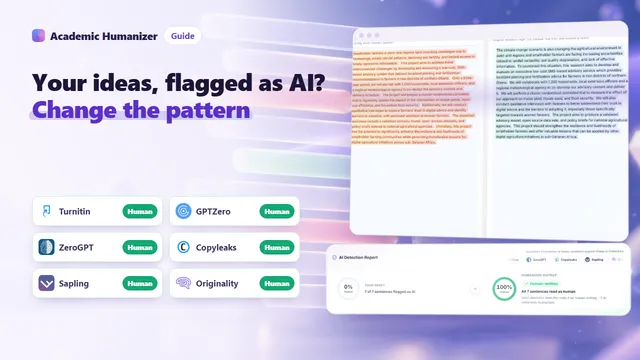
Academic Humanizer sits in the humanizer column, built for manuscripts, abstracts and research drafts. The Humanizer scans a draft for sentences AI detectors flag, rewrites only those while keeping the argument, numbers, citations and field terminology, and leaves sentences that already read as human exactly as written; if nothing is flagged, nothing changes and no credits are charged. The AI Detection Report pairs each flagged sentence with its rewrite so you can check every change, and the final read is always yours.
Your ideas, without the AI footprint
Paste a draft and see which sentences AI detectors flag, then humanize only those sentences.
Try Humanizer freeKeep reading
 Guide
How to Avoid AI Detection in Academic Writing (2026 Guide)
AI detectors flag patterns, not ideas. Ten practical techniques to keep your own argument and change what Turnitin and GPTZero measure, with real test data.
Read article
 Guide
Free AI Humanizer With No Word Limit: What You Give Up
Free, unlimited, no sign-up humanizers are paid for some other way. What you give up, and a 10-minute test you can run on any tool before trusting it with a paper.
Read article
 Guide
How to Humanize AI Text Manually: A Step-by-Step Method for Essays
An 8-step manual method to humanize AI text in essays and papers: cut filler, add your specifics, vary rhythm, hedge honestly and recheck every citation.
Read article