

What Makes a Strong Academic Style Different?
A sentence often becomes less scholarly at the exact moment its author tries to make it sound scholarly. “We compared the groups” turns into “A comparative evaluation of the groups was undertaken.”
Academic Voice Is Not About Using Bigger Words
A sentence often becomes less scholarly at the exact moment its author tries to make it sound scholarly. “We compared the groups” turns into “A comparative evaluation of the groups was undertaken.” “The interviews showed” becomes “It may be posited that the interview data are suggestive of.” The revision adds distance, nouns, and syllables, but it may remove the actor, blur the action, and make the strength of the finding harder to judge.
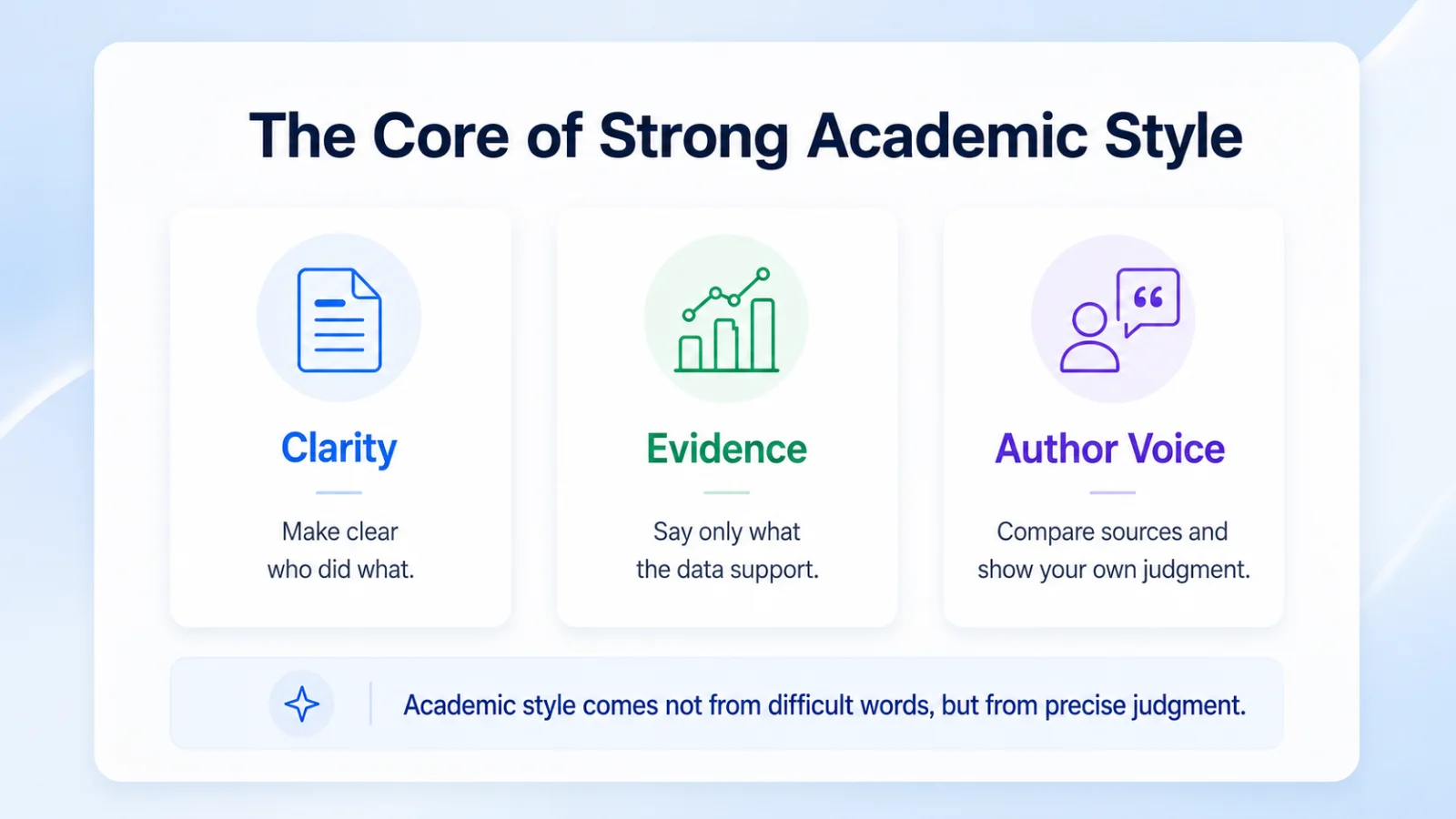
Academic voice is not a decorative register placed over completed thinking. It is the pattern of choices through which a writer shows what is known, where that knowledge comes from, how strongly the evidence supports a claim, and how the claim relates to other scholarship. Voice appears in the verbs used to report results, the way sources are grouped or challenged, the decision to name an actor, and the signals that distinguish observation from interpretation. First person can contribute to voice, but voice does not mean inserting “I” into every paragraph. Impersonal prose still has a writer behind it; it can make that writer's choices less visible without making them more objective.
University writing guides repeatedly separate academic authority from inflated language. The University of Nevada, Reno emphasizes evidence, neutral treatment of alternatives, and concision(1). Excelsior OWL rejects convoluted syntax and stilted abstraction as requirements of formality(2). Vanderbilt's guide warns against selecting unfamiliar words from a thesaurus merely to sound more academic(3).
These are pedagogical sources rather than controlled experiments, but they express a sound editorial principle: complexity is justified when the subject requires it, not when the writer wants to display status.
Authority comes from calibrated claims, not verbal difficulty
There is experimental evidence that unnecessary complexity can damage the impression it is intended to improve. In a series of studies with the deliberately elaborate title Consequences of Erudite Vernacular Utilized Irrespective of Necessity, needlessly complex wording generally reduced readers' judgments of an author's intelligence(4). The explanation involved processing fluency, or the ease with which a reader can mentally process a text. Difficult processing was not automatically interpreted as intellectual depth. This does not imply that every long word is bad.
“Heteroskedasticity,” a statistical term for unequal variation in errors, is more precise than a long everyday paraphrase when that concept itself is under discussion. The problem is complexity that adds no precision.
Scientific prose has, on broad measures, become harder to read. An eLife analysis examined 709,577 abstracts from 123 journals between 1881 and 2015 and found a long-term decline on two readability measures(5). Growth in general scientific jargon was one plausible contributor. Readability formulas estimate difficulty from surface features and cannot decide whether a technical concept is necessary, whether an argument is valid, or whether a short sentence is accurate. The study therefore does not establish a universal style rule. It does show how community habits can accumulate into barriers that writers no longer notice.
The stronger source of authority is the fit between claim and evidence. Compare “Remote work improves productivity” with “In this survey, employees reporting two remote days per week also reported higher individual productivity.” The first sentence states a broad causal conclusion. The second reports an association within a defined sample. If the study was cross-sectional, meaning that the variables were measured at one period rather than followed through time, relied on self-report, and did not assign work arrangements, the second may be the more authoritative sentence because it tells the truth about what was observed. Limiting a claim to its evidence is not timid writing. It is precise writing.
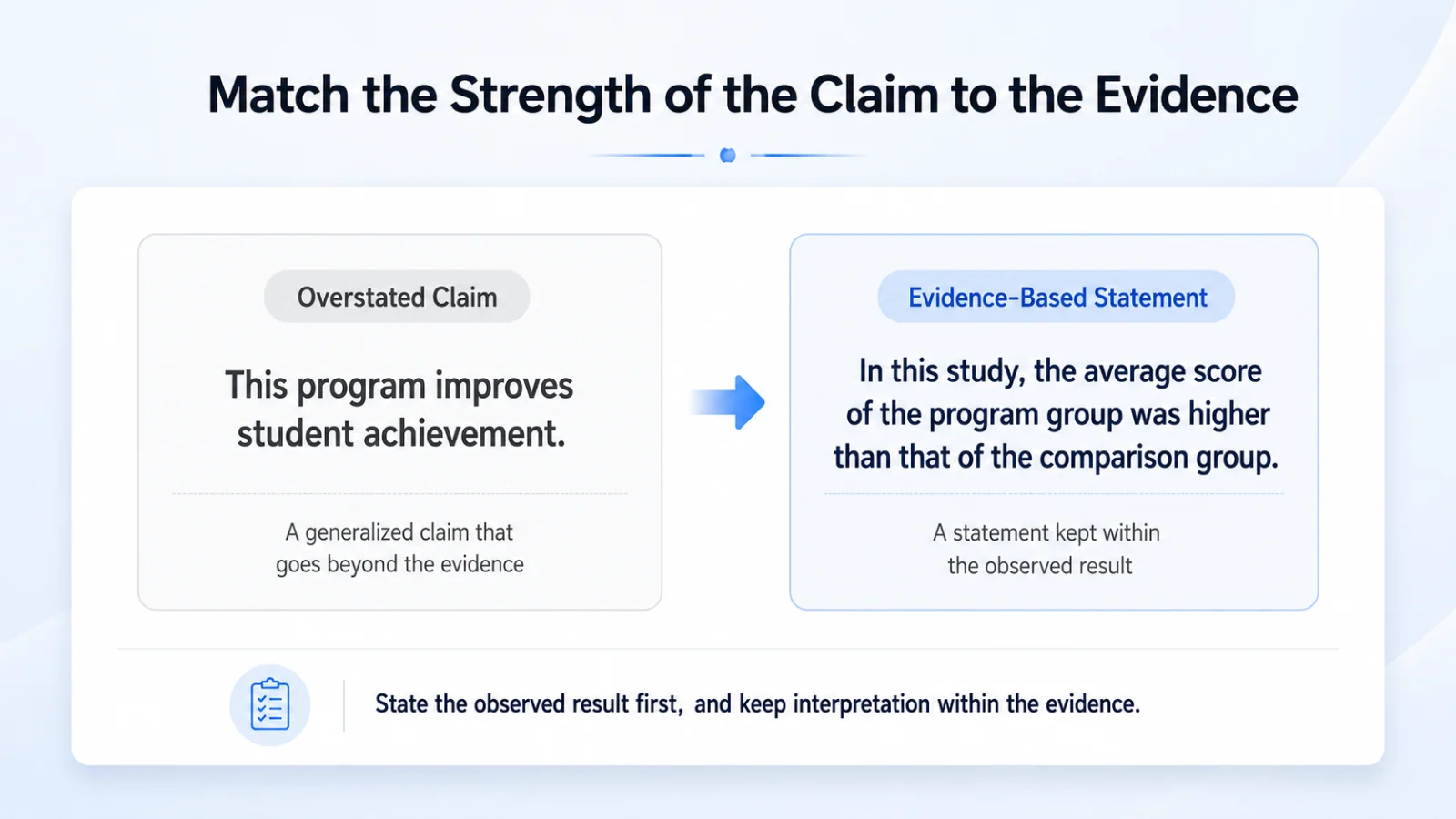
The language used to position a claim is often called stance. Stance tells readers whether the writer presents a proposition as an observation, inference, possibility, established fact, or contested interpretation. Verbs such as demonstrates, indicates, suggests, is consistent with, and may explain are not interchangeable ornaments. They carry different commitments. Good stance is not the habit of adding perhaps or may to every sentence. Direct evidence can be stated directly.
Uncertain mechanisms, limited ability to apply a result beyond the studied sample, and alternative explanations require corresponding restraint. Academic authority is not maximal confidence; it is confidence accurately measured against the evidence.
Visible actors support the same goal. “The data were coded” omits information that may matter. “Two researchers independently coded the interview transcripts and resolved disagreements by discussion” identifies the actors and procedure. Passive voice can be useful when the object or process deserves the sentence's opening position, or when the actor is genuinely irrelevant. George Mason University's guide to reducing informality treats voice choices as context-dependent rather than banning the passive(6). The question is not whether a sentence is active or passive. It is whether its information order serves the argument and whether responsibility remains clear.
Nominalization can obscure action in a similar way. A nominalization turns an action or quality into a noun: “we analyzed” becomes “the analysis of,” and “the temperature varied” becomes “temperature variation.” Nominalizations are useful when the resulting concept is the topic of discussion. They become a problem when several abstract nouns replace a clear actor and verb. “The implementation of an evaluation of the intervention was conducted” makes readers reconstruct the simpler proposition “We evaluated the intervention.” The EU guide How to Write Clearly and the Interuniversity Style Guide recommend concrete verbs and visible subject-verb relationships because they expose the research action(7)(8).
Voice is the relationship a writer creates among sources, readers, and claims
Writers can also disappear behind citations. A literature-review paragraph that says “Ahmed found X. Brown argued Y. Chen reported Z” contains source information but gives readers no reason those studies belong together. The opposite problem occurs when several studies are compressed into one generalization that conceals disagreement and methodological differences. Authorial voice lies in the responsible relationship between these extremes. The writer identifies a pattern, distinguishes exceptions, explains why methods lead to different conclusions, and keeps the boundary between a source's claim and the writer's interpretation visible.
Stanford's How to Use Sources Without Losing Your Voice describes how students can imitate the dry tone of their sources and suppress their own rhetorical presence(9). That presence is not achieved only through first person. It appears in decisions to quote, paraphrase, summarize, foreground, contrast, or qualify. “Lee found no association” reports a result. “Lee found no association, but the six-week observation period may not capture the delayed response proposed by Patel” shows why two sources are being brought into the same sentence and who is making the comparison.
Citation practices vary by discipline. A corpus study, which systematically analyzes an assembled collection of texts, examined 270 research-paper background sections across six fields and found differences in integral citations, which name the cited author in the sentence, and non-integral citations, which place the source in parentheses or a note(10). Fields also differed in their balance of individual summaries and broader generalizations, while direct quotation was rare across the published-paper corpus. These findings do not create a universal hierarchy. They show that a convincing scholarly presence depends partly on what a discourse community expects writers to foreground: an interpreting scholar, a cumulative result, a method, a text, or a historical debate.
First person must be judged in the same disciplinary and rhetorical context. “We classified the responses into three themes” may be more transparent than “The responses were classified into three themes,” because qualitative analysis involves researcher judgment. A first-person claim can also be unnecessary or self-promotional if the sentence is about an external result rather than the researcher's action. Academic Voice in Scholarly Writing argues that debates over personal-reflexive and distant-authoritative voices arise from different assumptions about knowledge, method, representation, and researcher position(11). Removing the pronoun does not remove those assumptions.
Voice is therefore not one personality imposed on every paper. Authorial Voice in Academic Writing reviews linguistic, psychological, and critical approaches and treats academic writing as persuasive interaction even when its surface is impersonal(12). Writers position propositions, arrange other voices, anticipate readers, and organize information. Those choices remain present in a technical report that never uses I. The important question is whether the choices help readers distinguish evidence, source, interpretation, and responsibility.
The issue is particularly visible for multilingual scholars. A narrative study of Norwegian doctoral researchers in teacher education found that scholarly identity developed through disciplinary conventions, mentoring, language choices, prior professional identities, and the need to represent local contexts accurately(13). Participants were not simply trying to imitate a generic native-English persona. They were learning how to become credible researchers while preserving knowledge rooted in another language and setting.
A recent systematic review of authorial stance and voice in second-language academic writing synthesized 72 empirical studies published from 2000 through 2024(14). Much of the literature used corpus-based comparisons in English-as-a-foreign-language settings, while instructional studies that followed writers over time were uncommon. The review associated over-assertive or insufficiently authoritative prose with limited awareness of genre and context, supporting explicit discipline-aware instruction rather than one generic list of voice markers. Its authors did not formally rate the methodological quality of the included studies, so its conclusions should guide teaching and inquiry rather than be treated as a final causal verdict.
Smaller instructional studies reinforce the difficulty of learning nuanced positions. A dissertation study of seven Mandarin-speaking social-science doctoral writers found that participants using a searchable collection of authentic stance examples learned extreme certainty or tentativeness more readily than intermediate positions that concede or qualify(15). A study of 44 students at the American University of Beirut described gradual improvement in incorporating external voices but continuing difficulty in maintaining and interweaving the writer's own position(16). These are context-specific studies, not population estimates. They help explain why telling writers to “sound confident” or “hedge more” is inadequate. The hard skill is selecting a position that fits this evidence, genre, and reader.
Revise the judgment before polishing the sentence
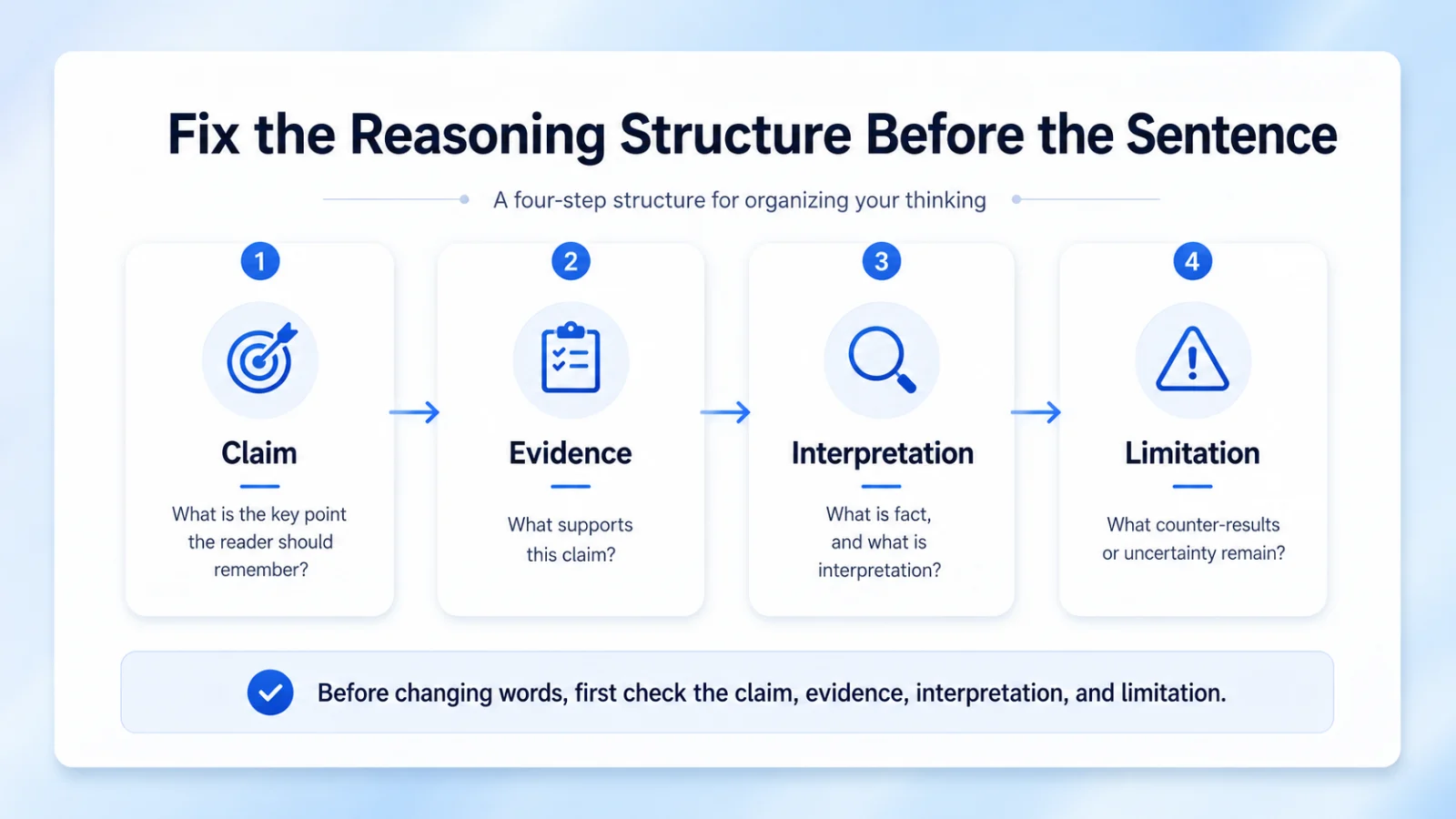
Editing for academic voice should begin above the word level. For each paragraph, identify the proposition the reader is expected to carry forward. Then identify the evidence supporting it, the point where observation becomes interpretation, and any alternative result or limitation that changes its scope. If that structure is missing, substituting formal synonyms will only make an unclear judgment sound heavier.
At sentence level, find the grammatical subject and main verb. Ask whether the subject is the real actor and whether the verb names the relationship precisely. “X affected Y” may hide several possibilities: X preceded a change in Y, X was correlated with Y, groups differed on Y, or participants described X as influencing Y. Writing Empirical Articles argues that transparency and reproducibility can coexist with clarity and memorability, and recommends precise verbs over vague relational language(17). A reader should not have to infer which analysis or observation the verb represents.
Technical terms should be managed rather than erased. When a specialist term names the concept more accurately than an everyday substitute, define it at first use if the expected reader may not know it, then use the same term consistently. Rotating through impressive synonyms can make one concept look like several. Abbreviations save attention only when a term recurs enough to justify remembering the abbreviation. Both NIH plain-language guidance and the US government's Writing for Understanding reject the idea that plain language is inaccurate, unprofessional, or patronizing(18)(19). Plain language remains complete and precise; it removes obstacles that do not serve the content.
Revision should also test the prose against its actual audience and genre. A methods section may repeat stable terminology because reproducibility is more important than stylistic variation. A humanities argument may need longer sentences to hold a qualification and its consequence together. An ethnography may require visible researcher reflexivity. A quantitative results section usually benefits from separating the observed result from its explanation. The CDC Domains of Excellence places clarity beside scientific rigor, ethics, relevance, collaboration, and equity rather than treating it as a substitute for them(20). Its public-health context is specific, but the relationship is widely useful: clear writing allows other dimensions of quality to be inspected.
Reading aloud provides a final practical test. A sentence with a distant subject and verb, stacked nominalizations, or too many embedded qualifications often becomes difficult to say before it becomes obviously difficult to see. A second reader can mark where the actor, claim, evidence, or logical connection becomes uncertain. “Does this sound robotic?” produces taste-based feedback. “At what point did you lose track of who did what, and which words state the evidence?” produces revisable information. The short editorial Clear, Simple, Precise, Meaningful rightly connects clarity to robust research, a visible core message, defined terms, and paragraph order rather than to word replacement alone(21).
Academic voice is not a uniform accent that makes every scholar sound the same. It is a disciplined relationship among writer, evidence, sources, readers, genre, and field. It can be personal or impersonal, active or passive, concise or syntactically complex when the purpose requires it. What it cannot afford to be is needlessly obscure. The most authoritative sentence is not the one that makes the author appear clever. It is the one that lets a reader see exactly what the evidence supports, who is responsible for the interpretation, and where uncertainty remains.
Sources
1. Academic Voice, University of Nevada, Reno - https://www.unr.edu/writing-speaking-center/writing-speaking-resources/academic-voice
2. Academic Voice, Excelsior OWL - https://owl.excelsior.edu/writing-process/finding-your-voice/finding-your-voice-academic-voice/
3. Academic Voice, Vanderbilt University - https://www.vanderbilt.edu/writing/resources/handouts/academic-voice/
4. Problems with Using Long Words Needlessly - https://doi.org/10.1002/acp.1178
5. The Readability of Scientific Texts Is Decreasing over Time - https://doi.org/10.7554/eLife.27725
6. Reducing Informality in Academic Writing - https://writingcenter.gmu.edu/writing-resources/grammar-style/reducing-informality-in-academic-writing
7. How to Write Clearly - https://op.europa.eu/en/publication-detail/-/publication/725b7eb0-d92e-11e5-8fea-01aa75ed71a1
8. Interuniversity Style Guide for Writing End-of-Degree Projects in English - https://www.upc.edu/slt/ca/redaccio-i-comunicacio/writing-resources/writing-science/interuniversity-style-guide-for-writing-end-of-degree-projects-in-english.pdf
9. How to Use Sources Without Losing Your Voice - https://teachingwriting.stanford.edu/how-use-sources-without-losing-your-voice
10. Authorial Voice in Academic Articles - https://doi.org/10.18552/joaw.v14i2.1041
11. Academic Voice in Scholarly Writing - https://doi.org/10.46743/2160-3715/2017.2362
12. Authorial Voice in Academic Writing - https://doi.org/10.4067/S0718-09342011000200001
13. Academic Writing, Scholarly Identity, Voice and Multilingualism - https://doi.org/10.1016/j.linged.2020.100883
14. Authorial Stance/Voice and L2 Academic Writing - https://doi.org/10.1016/j.jeap.2026.101725
15. Taking an Effective Authorial Stance in Academic Writing - https://hdl.handle.net/2027.42/77860
16. The Dance of Voices - https://doi.org/10.37514/INT-B.2017.0896.2.11
17. Writing Empirical Articles - https://doi.org/10.1177/2515245918754485
18. Plain Language at NIH - https://www.nih.gov/institutes-nih/nih-office-director/office-communications-public-liaison/clear-communication/plain-language-nih
19. Writing for Understanding - https://digital.gov/guides/plain-language/writing
20. CDC Domains of Excellence - https://stacks.cdc.gov/view/cdc/147695
21. Clear, Simple, Precise, Meaningful - https://doi.org/10.4103/IJPC.IJPC_175_18