

How to Bypass AI Detection in a Research Paper or Thesis
Detectors flag the framing prose of a paper, not the methods. A section-by-section guide to fixing flagged sentences while keeping every citation and number.
To get a research paper or thesis past AI detection without damaging it, work section by section and rewrite only the sentences a detector flags. In academic manuscripts, detectors mostly flag the framing prose: abstract claims, the opening of the introduction, literature review transitions and the closing lines of the discussion. Methods and results, which are dense with numbers and fixed reporting language, are flagged far less often and carry the most risk when rewritten. After any rewrite, check every citation, number, hedge and technical term against your source draft.
This guide is for researchers whose own work, or AI-assisted drafting their institution or journal allows, is being read as machine text. It uses real detector results from our case runs, and it ends with the disclosure rules you still have to follow. A cleaner score never replaces a required AI declaration.
What AI detectors flag in a research paper, section by section
Detectors score how predictable the wording is. Research papers vary a lot in that respect from one section to the next, which is why a whole-paper rewrite is the wrong tool.
| Section | What tends to get flagged | What to do |
|---|---|---|
| Abstract | Opening threat statements, "comprehensive dataset", "underscore the importance", contribution claims | Rewrite flagged lines; keep every number and the study design |
| Introduction | Generic first and last sentences, "growing body of literature" | Open with your specific problem, not the field in general |
| Literature review | Stock transitions, "garnered considerable attention", gap statements | Rewrite around the citations; never move or merge them |
| Methods | Often inconclusive rather than flagged | Usually leave alone; small manual edits at most |
| Results | Interpretive sentences more than statistics | Edit interpretation only; do not touch values |
| Discussion and conclusion | "Has the potential to significantly", "valuable insights", final summary lines | Replace with your actual implications and limits |
| References | Excluded by Turnitin | Leave as formatted |
The references row comes from Turnitin's own release notes: since August 2023, bibliographies are excluded from the AI writing report. Its FAQ adds that only prose sentences count, not bullet points or other non-sentence text. If your reference list was highlighted anyway, see why Turnitin flagged your references and citations.
Abstract: the most flagged paragraph in your paper
Abstracts compress claims into a few sentences, and AI drafts fill them with the most probable framing. In our test run on an AI-drafted public health abstract, all seven sentences were flagged and all five detector models voted AI. After the Humanizer rewrote those seven sentences, one of five voted AI and the report verdict was Human-written.
Every number survived: 2015 to 2022, 214 census tracts, 38% more heat-related visits. But one hedge did not. "Suggesting a cumulative cooling effect" disappeared from the output. That may be a defensible cut or a lost finding, and only the author can decide. The full line-by-line review is in our abstract case study.
Introduction and literature review: rewrite around the citations
Literature reviews are where AI drafting sounds most like AI: "has garnered considerable attention", "numerous studies have highlighted", "despite these advances, a notable gap remains". In our education literature review run, all eight sentences were flagged. After rewriting, one of five models voted AI, and all four in-text citations stayed attached to the right claims.
Before
For instance, Hattie and Timperley (2007) emphasized that the impact of feedback depends heavily on its focus, timing, and the extent to which it addresses the gap between current and desired performance.
After
Hattie and Timperley (2007), for example, found that the effectiveness of feedback varies based on its focus, timing, and whether it highlights the gap between current and desired performance.
Note the verb. "Emphasized" became "found", which changes what you say the source did. That is the kind of drift to catch. The same run also turned "class sizes frequently exceed several hundred students" into "over a hundred", a factual weakening of the motivation. Read every rewritten sentence next to its source, with the cited paper in mind. More in our literature review case study.
Methods and results: usually leave them alone
We expected an AI-drafted psychology methods section to be heavily flagged. It was not. Every sentence came back inconclusive, three of five models leaned AI on the whole text and two did not, and the report verdict was Human-written. With nothing flagged, the Humanizer changed nothing and charged nothing.
That fits how methods prose works. Human researchers write "participants were randomly assigned to one of four conditions" from the same templates, and strings like "M = 34.7, SD = 11.2" dilute any stylistic signal. Meanwhile, a methods section holds a dozen values that must not move. A tool that paraphrases everything gives each of them a chance to be rounded or attached to the wrong variable. If a sentence or two is flagged, edit it by hand: "used" for "employed", "Then" for "Subsequently". See the methods case study.
Results follow the same logic. Reported statistics carry little stylistic signal, while interpretive sentences ("these findings clearly demonstrate") read like any other prose and can be flagged like it. Rewrite the interpretation if it is flagged. Leave the numbers exactly as your analysis output gives them.
Discussion and conclusion: say what you actually found
Closing paragraphs collect the most inflated language in any AI draft. Turnitin noted in May 2023 that it had seen more false positives in the first and last few sentences of documents, often generic introduction and conclusion content, and adjusted its logic. Generic closings are a risk for human writers too.
The fix is content, not synonyms. Replace "this research contributes valuable insights to the growing body of literature" with the one implication your data supports, the limit that most constrains it, and the next study you would run. In our grant summary run, a sentence beginning "Ultimately, this project has the potential to significantly enhance" became "This project should strengthen", and the summary went from five of five models voting AI to none. The same run dropped "over a three-year period" from another sentence, a core commitment a reviewer would check. See the grant proposal case study.
AI detection in a thesis or dissertation
A thesis adds length and history. Turnitin scores up to 30,000 words of qualifying text per submission, so a long dissertation may be checked in parts, and a chapter submitted earlier may be scored by an older model. Turnitin says reports are not recalculated unless the file is resubmitted. Practical points:
- Work chapter by chapter. The literature review chapter and the closing chapter usually need the most attention.
- Keep your supervisor in the loop. Comments and earlier drafts they have seen are your best record of authorship.
- Keep version history. If a chapter is ever questioned, a document that grew over months is strong evidence. Export it before you need it.
- Do not rewrite quoted material. Direct quotations, legal text and standard definitions stay verbatim.
Checklist after any rewrite
Journal and university disclosure rules
Detection and disclosure are separate questions. Turnitin positions its detector for publishers and researchers as well as educators, and policies differ by venue. Elsevier's generative AI policy for journals, for example, asks for a declaration naming the tool, its purpose and confirmation that the authors reviewed the output, placed before the references. Basic grammar, spelling and punctuation checks are exempt, and AI tools cannot be listed as authors. Universities set their own rules for theses. Read the policy for your venue before you submit, not after a query.
FAQ
Can Turnitin detect AI in a thesis?
Yes, if your university runs the thesis through Turnitin with AI detection enabled. It scores long-form prose of 300 to 30,000 qualifying words per submission.
Is it okay to use AI to write a research paper?
Many publishers allow some AI assistance with disclosure and full author responsibility, and forbid listing AI as an author. Check your target journal's policy.
How do I humanize a research paper without changing the meaning?
Rewrite only flagged sentences, leave methods and statistics alone where possible, and compare every rewritten sentence against the original using the checklist above.
Why was my literature review flagged as AI when I wrote it?
Review prose is formulaic by nature. Stock transitions and summary phrasing look predictable to detectors whoever wrote them.
How Academic Humanizer handles a manuscript
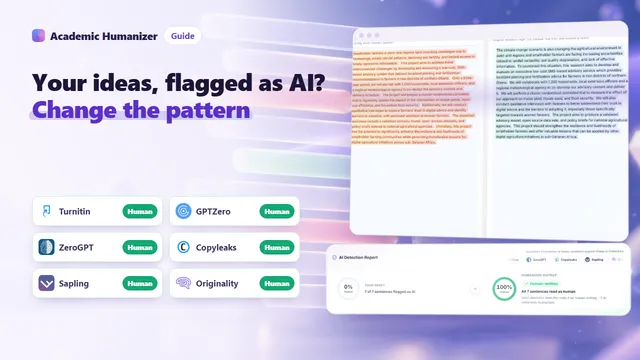
Academic Humanizer was built for this job. The Humanizer scans each sentence, rewrites only those detectors flag, and leaves the rest exactly as you wrote them, with an optional research field setting to keep terminology in register. The AI Detection Report pairs each flagged sentence with its rewrite and compares both versions, checked against Turnitin, GPTZero, ZeroGPT, Copyleaks, Sapling and Originality.ai. Each run takes up to 10,000 characters, so a thesis goes through a section at a time. It cannot guarantee a detector result, and the meaning check stays with you. For the general techniques, read how to avoid AI detection in academic writing.
Your ideas, without the AI footprint
Paste a draft and see which sentences AI detectors flag, then humanize only those sentences.
Try Humanizer freeKeep reading
 Guide
How to Avoid AI Detection in Academic Writing (2026 Guide)
AI detectors flag patterns, not ideas. Ten practical techniques to keep your own argument and change what Turnitin and GPTZero measure, with real test data.
Read article
 Guide
Free AI Humanizer With No Word Limit: What You Give Up
Free, unlimited, no sign-up humanizers are paid for some other way. What you give up, and a 10-minute test you can run on any tool before trusting it with a paper.
Read article
 Guide
How to Humanize AI Text Manually: A Step-by-Step Method for Essays
An 8-step manual method to humanize AI text in essays and papers: cut filler, add your specifics, vary rhythm, hedge honestly and recheck every citation.
Read article