

AI Literature Review Detection: A Real Test with Citations Checked
We ran an AI-drafted literature review paragraph through Humanizer v2. Every citation survived intact. Some of the claims attached to them shifted.
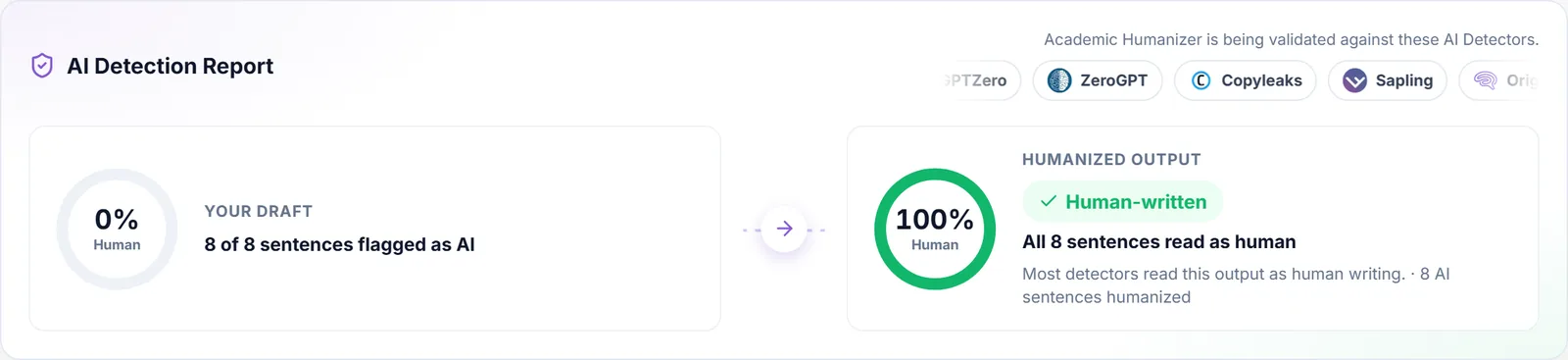
Do AI detectors catch an AI-drafted literature review? In our test they did, without exception: all five detector models voted AI on the draft and all eight sentences were flagged. The paragraph came from education research, and we ran it through Humanizer v2. After the run, four of five models voted human, every sentence read as human, and all four citation groups came through intact.
The citations survived. Some of the claims attached to them did not survive unchanged, and that is the part worth reading closely.
Why literature review prose gets flagged
A literature review paragraph has a predictable shape: the field is growing, studies show benefits, effects vary, one more recent strand matters, a gap remains, research is needed. Language models reproduce that shape fluently, and they decorate it with the same connectors every time. Our draft opened sentences with "In recent years", "However", "For instance", "Moreover", "Despite these advances" and "Consequently", and it used "garnered considerable attention" and "a pressing need".
In recent years, the integration of formative assessment practices into higher education has garnered considerable attention from researchers and practitioners alike. Numerous studies have highlighted the potential of formative feedback to enhance student learning outcomes, foster self-regulated learning, and promote deeper engagement with course content (Black & Wiliam, 1998; Nicol & Macfarlane-Dick, 2006). However, the effectiveness of such practices is not uniform across contexts. For instance, Hattie and Timperley (2007) emphasized that the impact of feedback depends heavily on its focus, timing, and the extent to which it addresses the gap between current and desired performance. Moreover, recent scholarship has increasingly recognized the role of student feedback literacy in determining whether feedback is actually used (Carless & Boud, 2018). Despite these advances, a notable gap remains in understanding how large-enrollment courses can implement formative assessment at scale without overburdening instructors. This gap is particularly salient in the context of introductory STEM courses, where class sizes frequently exceed several hundred students. Consequently, there is a pressing need for research that examines scalable, technology-supported approaches to formative feedback in such settings.
Real scan from our test run. All eight sentences flagged as AI.Even the short, plain sentence "However, the effectiveness of such practices is not uniform across contexts" was flagged. Detectors read a paragraph's rhythm as well as its vocabulary, and a run of evenly built sentences pulls each of them toward the AI side.
The run
- Scanning for AI signalsEight of eight sentences flagged; all five models voted AI.
- Rewriting flagged sentencesAll eight sentences were rewritten, with the citations carried into each new sentence.
- Re-checking with AI detectorsEight of eight sentences now read as human; four of five models vote human.
- Saving your result1,320 characters at 500 characters per credit, rounded up: 3 credits.
- AI-drafted paragraph5 of 5
- Humanizer v2 output1 of 5
Did the citations survive?
All of them, character for character. That matters more in a review than anywhere else, because a mangled year or a dropped co-author is the kind of error that costs credibility with a reviewer who knows the field.
| Citation | In the output? | What changed around it |
|---|---|---|
| Black & Wiliam, 1998 | Yes, unchanged | "Potential" to "efficacy" in the claim it supports |
| Nicol & Macfarlane-Dick, 2006 | Yes, unchanged | Same sentence as above |
| Hattie and Timperley (2007) | Yes, unchanged | "Emphasized" became "found"; "addresses the gap" became "highlights the gap" |
| Carless & Boud, 2018 | Yes, unchanged | The term "feedback literacy" was dropped |
So the references are safe. The attribution is where you need to look: a citation is a promise that the cited work says what your sentence says it does. If a detector flags the reference list itself, that is a different problem, covered in why Turnitin flags references and citations as AI.
How the hedging changed
Hedging in a literature review is not decoration. "Highlighted the potential" and "shown the efficacy" make different claims about the evidence, and a reader in your field will notice which one you chose.
Before
Numerous studies have highlighted the potential of formative feedback to enhance student learning outcomes, foster self-regulated learning, and promote deeper engagement with course content (Black & Wiliam, 1998; Nicol & Macfarlane-Dick, 2006). For instance, Hattie and Timperley (2007) emphasized that the impact of feedback depends heavily on its focus, timing, and the extent to which it addresses the gap between current and desired performance. Moreover, recent scholarship has increasingly recognized the role of student feedback literacy in determining whether feedback is actually used (Carless & Boud, 2018).
After
Many studies have shown the efficacy of formative feedback in improving student learning, facilitating self-regulated learning and enhancing students’ engagement with the course material (Black & Wiliam, 1998; Nicol & Macfarlane-Dick, 2006). Hattie and Timperley (2007), for example, found that the effectiveness of feedback varies based on its focus, timing, and whether it highlights the gap between current and desired performance. More recently, there has been a growing literature that links feedback effectiveness to the ability of students to interpret feedback (Carless & Boud, 2018).
Read as a reviewer would, the changes fall into three groups.
- Stronger claims. "Highlighted the potential" became "shown the efficacy". The draft's wording was more cautious, and caution is usually the safer position when summarizing a body of work.
- Different verbs of attribution. Hattie and Timperley's paper is a review that builds a model of feedback. "Emphasized" fits that; "found" suggests an empirical result. And feedback that "addresses" the gap is not the same as feedback that "highlights" it: one closes the gap, the other points at it.
- A lost term. "Student feedback literacy" is the concept Carless and Boud are known for. The rewrite paraphrases it as students' "ability to interpret feedback", and "whether feedback is actually used" (uptake) became interpretation. An author citing that paper would want the term back.
What changed in the gap statement
The last three sentences carry the paragraph's argument: here is what is missing, here is where it matters, here is what is needed. Two details shifted.
- "Class sizes frequently exceed several hundred students" became "many classes have over a hundred students". That is a factual weakening. If your motivation rests on very large classes, restore it.
- "How large-enrollment courses can implement formative assessment at scale without overburdening instructors" became a lack of research on implementation "in large enrolling courses". The instructor-workload angle, which is the actual gap, is gone, and "large enrolling courses" is awkward.
There is also some irony. The rewrite introduced "one crucial limitation" and "significant differences", two words careful editors trim. "Significant" in particular can be misread as a statistical claim in an education paper. Detectors read the sentences as human anyway, which shows that the scan and the house style are separate judgements.
A review routine for humanized literature reviews
- Check every citation against your reference manager: authors, year, punctuation.
- For each citing sentence, ask whether the cited work actually says the new version. Pay most attention to verbs: found, showed, argued, emphasized, suggested.
- Restore field terms that were paraphrased away. Named concepts are what connect your review to the literature.
- Compare quantities and scope words ("several hundred", "at scale", "without overburdening instructors").
- Check your institution's or journal's AI policy before submission.
Our guides on citation habits for AI-assisted research and keeping academic terminology intact go further on each step.
Where this leaves you
On detection, this run did what a literature review writer would want: eight flagged sentences became eight human-read sentences, and the citations came through untouched. On meaning, it produced a draft that needs a focused edit of perhaps five phrases. That is a reasonable trade, as long as the edit happens.
Academic Humanizer is built around that edit. The AI Detection Report lines up each original sentence with its rewrite so you can check attribution and hedging pair by pair, instead of comparing two paragraphs by eye.
Your ideas, without the AI footprint
Paste a draft and see which sentences AI detectors flag, then humanize only those sentences.
Try Humanizer freeKeep reading
 Case study
Grant Proposal AI Writing: A Real Test and the Review It Needs
Five AI votes became zero on an AI-drafted grant summary. The rewrite also dropped a three-year duration and added "innovative". The review step matters.
Read article
 Case study
Methods Section AI Detection: Why Humanizer Left This One Alone
An AI-drafted methods section split the detectors three to two, every sentence was inconclusive, and Humanizer v2 changed nothing. Here is why.
Read article
 Case study
Do AI Detectors Flag Non-Native English Writers? A Real Test
A non-native English researcher's own discussion paragraph, formulaic but human. Four of five detector models read it as human, and Humanizer v2 left it alone.
Read article