

Do AI Detectors Flag Non-Native English Writers? A Real Test
A non-native English researcher's own discussion paragraph, formulaic but human. Four of five detector models read it as human, and Humanizer v2 left it alone.
Do AI detectors flag non-native English writing as AI? Published research says they often do, but in our test of a real researcher's own discussion paragraph, they did not. Formulaic phrasing, a limited set of connectors and textbook sentence patterns are exactly what detectors are suspected of punishing, so we tested a paragraph written by hand by a non-native English researcher in materials science, the kind of text that worry is about.
The result was undramatic, and that is the point. Four of five detector models read it as human, no sentence was flagged, Humanizer v2 changed nothing, and the run cost nothing.
Why this text looked at risk
Read it as a detector might. Sentences start with stock frames: "In this study, we found that", "It is considered that", "Therefore, it is important to", "These results suggest that". The vocabulary is narrow and repeated. The grammar carries the marks of someone who learned English as a second language: "The reason of this improvement", "the tensile strength was decreased", "for obtaining the best mechanical properties".
The research behind the worry is real. Liang and colleagues at Stanford ran essays written for the TOEFL by non-native speakers through seven widely used GPT detectors and found an average false positive rate of 61.22%. Of those essays, 97.80% were flagged as AI-generated by at least one detector. We summarize the paper in GPT detectors are biased against non-native writers.
So a fair prediction would have been at least some flagged sentences. That is not what happened.
What the detectors said
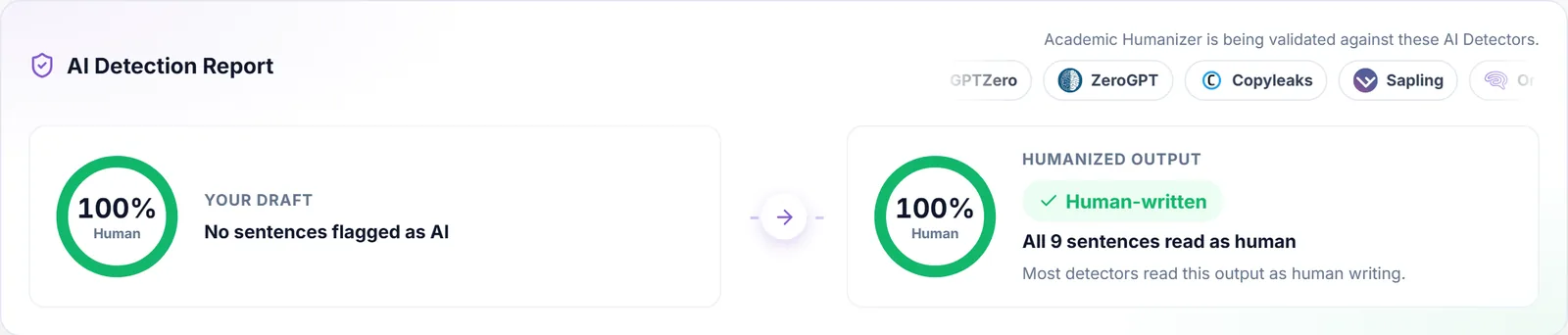
The report verdict on the draft was Human-written. Four of the five detector models voted human and one voted AI. At sentence level, all nine sentences were read as human; none was flagged and none was inconclusive.
In this study, we found that the addition of 2 wt% graphene oxide improved the tensile strength of the epoxy composite by 27% compared to the neat epoxy. This result is consistent with the previous studies which reported similar improvement in the range of 20-35%. The reason of this improvement can be explained by the good dispersion of graphene oxide sheets in the matrix and the strong interfacial bonding between the oxygen functional groups and the epoxy chains. However, when the content was increased to 3 wt%, the tensile strength was decreased. It is considered that the agglomeration of graphene oxide sheets occurred at higher content, and these agglomerates acted as stress concentration points. This tendency was also confirmed by the SEM images, which showed the clusters of sheets on the fracture surface. Therefore, it is important to optimize the filler content for obtaining the best mechanical properties. In addition, the glass transition temperature was slightly increased from 142 to 147 degrees, which means the mobility of polymer chains was restricted by the graphene oxide. These results suggest that the graphene oxide/epoxy composite can be a promising material for the lightweight structural applications.
Real scan from our test run. All nine sentences read as human.- Original paragraph1 of 5
- Humanizer v2 output (unchanged)1 of 5
What Humanizer v2 did: nothing, on purpose
Humanizer v2 rewrites only sentences that detectors flag. With zero flagged sentences there was nothing to rewrite, so the output is the input, character for character.
- Scanning for AI signalsNine sentences scanned; none flagged, all nine read as human.
- Rewriting flagged sentencesNothing to rewrite, so zero sentences changed.
- Re-checking with AI detectorsSame text, same result: Human-written, four of five models voting human.
- Saving your resultA run with zero changes costs 0 credits, though 1,235 characters would otherwise be 3.
This is the behaviour that matters most for non-native writers. A tool that paraphrases everything would have replaced this author's sentences with someone else's, introduced new phrasing that detectors might react to, and charged for the privilege. Leaving human writing alone is not a missing feature. It is the design.
Reading this result carefully
One test paragraph does not overturn a published study, and it should not be read as "detectors are fine with non-native writing now". Three cautions:
- The disagreement was real. One of five models voted AI. If you had checked with a single tool that behaves like that one, you would have seen an AI verdict on text a human wrote. That is the pattern Liang and colleagues documented, and it is why we compare several models instead of trusting one. See why AI detectors disagree.
- Discussion sections carry specifics. This paragraph is full of concrete values (2 wt%, 27%, 20-35%, 3 wt%, 142 to 147 degrees) and named evidence (SEM images, fracture surface). Text tied to particular results may read differently from a short general essay of the kind the TOEFL study used.
- Your text is not this text. A paragraph with more generic framing could be flagged. The report tells you sentence by sentence, which is more useful than a single score.
Grammar is a separate job
Passing as human is not the same as being ready for a journal. The paragraph still has errors a copy editor would mark, and a humanizer is not the tool to fix them. Its job is to change sentences detectors flag; it does not touch sentences that are already read as human, errors included.
Before
The reason of this improvement can be explained by the good dispersion of graphene oxide sheets in the matrix and the strong interfacial bonding between the oxygen functional groups and the epoxy chains. However, when the content was increased to 3 wt%, the tensile strength was decreased. In addition, the glass transition temperature was slightly increased from 142 to 147 degrees, which means the mobility of polymer chains was restricted by the graphene oxide.
After
The reason for this improvement can be explained by the good dispersion of graphene oxide sheets in the matrix and the strong interfacial bonding between the oxygen functional groups and the epoxy chains. However, when the content was increased to 3 wt%, the tensile strength decreased. In addition, the glass transition temperature was slightly increased from 142 to 147 °C, which means the mobility of polymer chains was restricted by the graphene oxide.
The last edit assumes the values are in degrees Celsius; only the author knows the unit, and the original leaves it out. Other candidates: "the previous studies which reported" (drop "the"), "for the lightweight structural applications" (drop "the"), and "It is considered that", which many journals would turn into "We attribute this to".
One practical note. If you run this paragraph through an AI grammar or polishing tool, the edited version may read differently to detectors than your original did. Re-check it afterwards. The report has a verdict for that case, Human-written & AI-refined, so you can see where you stand. Our comparison of humanizers, paraphrasers and grammar checkers explains which tool does which job.
What this means for non-native English researchers
If you write your own drafts in a formal, formulaic style, the risk of a false flag is real but not certain, and the right response is to check, not to rewrite pre-emptively. Rewriting human text to look "more human" can make things worse.
Academic Humanizer was built with that in mind: it scans your draft, rewrites only the sentences detectors flag, returns your own sentences untouched, and charges nothing when nothing changes. If you have been flagged already, our guide on what to do if you are falsely flagged as AI is a good next read.
Your ideas, without the AI footprint
Paste a draft and see which sentences AI detectors flag, then humanize only those sentences.
Try Humanizer freeKeep reading
 Case study
Grant Proposal AI Writing: A Real Test and the Review It Needs
Five AI votes became zero on an AI-drafted grant summary. The rewrite also dropped a three-year duration and added "innovative". The review step matters.
Read article
 Case study
Methods Section AI Detection: Why Humanizer Left This One Alone
An AI-drafted methods section split the detectors three to two, every sentence was inconclusive, and Humanizer v2 changed nothing. Here is why.
Read article
 Case study
AI Literature Review Detection: A Real Test with Citations Checked
We ran an AI-drafted literature review paragraph through Humanizer v2. Every citation survived intact. Some of the claims attached to them shifted.
Read article