AI检测器会误判非母语英文写作吗?一次真实测试
一位非母语英文研究者亲手写的讨论段落,句式套路化但确实出自人手。五个检测模型中四个判为人写,Humanizer v2 没有改动。
AI 检测器会把非母语者写的英文误判为 AI 吗?已发表的研究表明经常会,但在我们对一位真实研究者亲手写的讨论段落的测试中,并没有。套路化的措辞、有限的连接词和教科书式的句型,恰恰是人们怀疑检测器会“惩罚”的特征,所以我们测试了一段由材料科学领域的非母语英文研究者亲手写的段落,正是这种担忧所指的那类文字。
结果平淡无奇,而这正是重点。五个检测模型中有四个判为人写,没有句子被标记,Humanizer v2 没有任何改动,本次运行也没有扣费。
为什么这段文字看起来有风险
用检测器的眼光读一读。句子以固定套路开头:"In this study, we found that"、"It is considered that"、"Therefore, it is important to"、"These results suggest that"。词汇面窄且反复出现。语法上带有以英语为第二语言的人的痕迹:"The reason of this improvement"、"the tensile strength was decreased"、"for obtaining the best mechanical properties"。
这种担忧背后的研究是真实的。斯坦福大学的 Liang 等人把非母语者为 TOEFL 写的作文交给七个常用的 GPT 检测器,发现平均误报率为 61.22%。这些作文中有 97.80% 至少被一个检测器判为 AI 生成。我们在GPT 检测器对非母语写作者存在偏见一文中概述了这篇论文。
所以合理的预测是至少会有一些句子被标记。但实际并非如此。
检测器怎么说
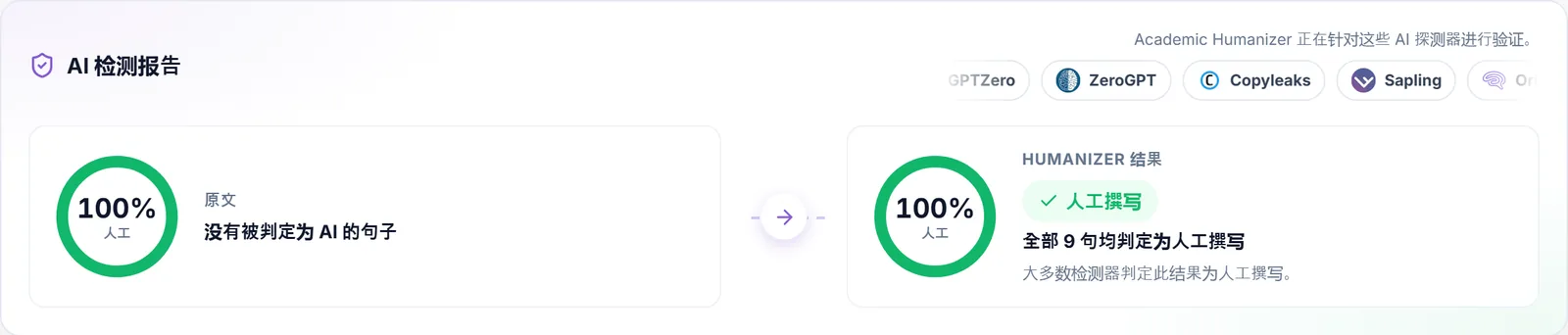
报告对这份草稿的结论是“人工撰写”。五个检测模型中四个判为人写,一个判为 AI。在句子层面,九个句子全部被判为人写,没有一句被标记,也没有一句是“不确定”。
In this study, we found that the addition of 2 wt% graphene oxide improved the tensile strength of the epoxy composite by 27% compared to the neat epoxy. This result is consistent with the previous studies which reported similar improvement in the range of 20-35%. The reason of this improvement can be explained by the good dispersion of graphene oxide sheets in the matrix and the strong interfacial bonding between the oxygen functional groups and the epoxy chains. However, when the content was increased to 3 wt%, the tensile strength was decreased. It is considered that the agglomeration of graphene oxide sheets occurred at higher content, and these agglomerates acted as stress concentration points. This tendency was also confirmed by the SEM images, which showed the clusters of sheets on the fracture surface. Therefore, it is important to optimize the filler content for obtaining the best mechanical properties. In addition, the glass transition temperature was slightly increased from 142 to 147 degrees, which means the mobility of polymer chains was restricted by the graphene oxide. These results suggest that the graphene oxide/epoxy composite can be a promising material for the lightweight structural applications.
我们测试运行的真实扫描结果。九个句子全部被判为人写。- 原始段落1 / 5
- Humanizer v2 输出(未改动)1 / 5
Humanizer v2 做了什么:刻意什么都没做
Humanizer v2 只改写被检测器标记的句子。被标记的句子为零,也就没有可改写的内容,所以输出就是输入,逐字符一致。
- 扫描 AI 信号扫描了九个句子;没有句子被标记,九句全部被判为人写。
- 改写被标记的句子没有需要改写的内容,改动了零个句子。
- 用 AI 检测器复查文本相同,结果相同:人工撰写,五个模型中四个判为人写。
- 保存结果零改动的运行扣费 0 点,否则 1,235 个字符需要 3 点。
对非母语写作者来说,这才是最重要的行为。全文改写的工具会把这位作者的句子换成别人的句子,引入检测器可能有反应的新措辞,还要为此收费。不去动人写的文字,并不是缺了什么功能,而正是设计本身。
审慎解读这个结果
一段测试文字推翻不了一项已发表的研究,也不应被解读为“检测器现在对非母语写作没问题了”。有三点需要注意:
- 分歧是真实存在的。五个模型中有一个判为 AI。如果你只用一个表现像它那样的工具检测,就会看到一份把人写的文字判为 AI 的结论。这正是 Liang 等人记录的模式,也是我们比较多个模型而不是只信一个的原因。参阅为什么 AI 检测器结果不一致。
- 讨论部分包含具体内容。这段文字充满了具体数值(2 wt%、27%、20-35%、3 wt%、142 到 147 度)和有名称的证据(SEM 图像、断裂面)。与具体结果挂钩的文字,在检测器看来可能与 TOEFL 研究所用的那种简短的泛泛而谈的作文不同。
- 你的文字不是这段文字。表述更泛泛的段落可能会被标记。报告会逐句告诉你结果,这比单一分数更有用。
语法是另一回事
被判为人写,不等于已经可以投期刊了。这段文字仍有文字编辑会标出的错误,而降 AI 工具并不是用来修正这些错误的。它的工作是改写被检测器标记的句子;已经被判为人写的句子,包括其中的错误,它都不会碰。
改写前
The reason of this improvement can be explained by the good dispersion of graphene oxide sheets in the matrix and the strong interfacial bonding between the oxygen functional groups and the epoxy chains. However, when the content was increased to 3 wt%, the tensile strength was decreased. In addition, the glass transition temperature was slightly increased from 142 to 147 degrees, which means the mobility of polymer chains was restricted by the graphene oxide.
改写后
The reason for this improvement can be explained by the good dispersion of graphene oxide sheets in the matrix and the strong interfacial bonding between the oxygen functional groups and the epoxy chains. However, when the content was increased to 3 wt%, the tensile strength decreased. In addition, the glass transition temperature was slightly increased from 142 to 147 °C, which means the mobility of polymer chains was restricted by the graphene oxide.
最后一处修改假定数值单位是摄氏度;只有作者知道单位,原文没有写明。其他可改之处还有:"the previous studies which reported"(去掉 "the")、"for the lightweight structural applications"(去掉 "the"),以及 "It is considered that",很多期刊会把它改成 "We attribute this to"。
还有一点实用提示。如果你用 AI 语法或润色工具处理这段文字,修改后的版本在检测器看来可能与原稿不同。处理后请再检测一次。报告针对这种情况有一个专门的结论“人工撰写且经 AI 润色”(Human-written & AI-refined),让你清楚自己的处境。我们对降 AI 工具、改写工具和语法检查工具的比较说明了各个工具分别做什么。
这对非母语英文研究者意味着什么
如果你用正式、套路化的风格亲自写稿,被误判的风险是真实的,但并非必然,正确的做法是先检测,而不是预先改写。为了让人写的文字看起来“更像人写的”而去改写,反而可能适得其反。
Academic Humanizer 正是基于这一点设计的:它扫描你的稿件,只改写被检测器标记的句子,你自己的句子原样返回,没有改动时不收费。如果你已经被误判,下一步可以阅读我们的指南被误判为 AI 时该怎么办。
保留你的想法,去除 AI 痕迹
粘贴草稿,查看哪些句子被 AI 检测器标记,然后只用 Humanizer 改写这些句子。
免费试用 Humanizer