

Methods Section AI Detection: Why Humanizer Left This One Alone
An AI-drafted methods section split the detectors three to two, every sentence was inconclusive, and Humanizer v2 changed nothing. Here is why.
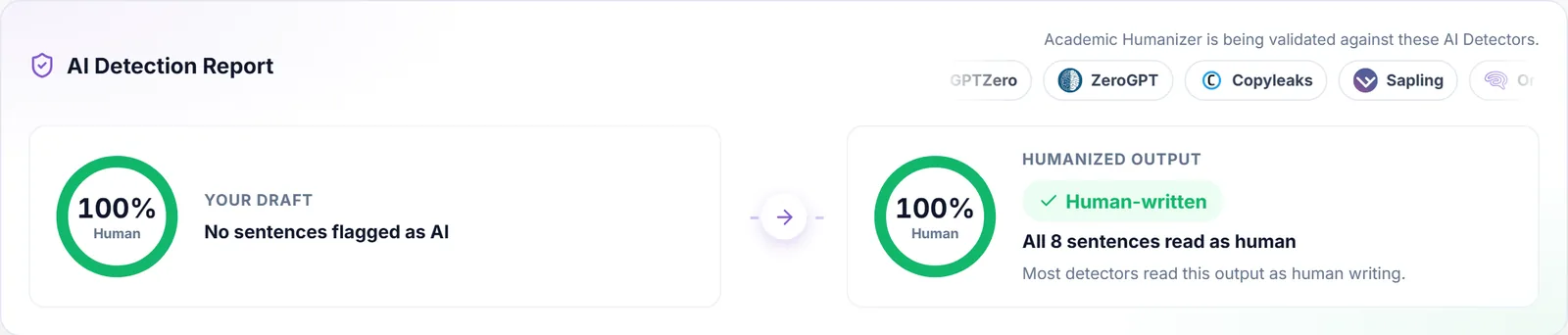
Methods sections behave differently under AI detection. We ran an AI-drafted psychology methods section through Humanizer v2, expecting a list of flagged sentences. Instead, every sentence came back inconclusive, the report verdict was Human-written, and Humanizer v2 changed nothing and charged nothing.
The detectors did not agree with each other, though: three of five models voted AI and two voted human. This post explains what that split means, why methods prose produces it, and what an author should take from a run that leaves the text alone.
The text
The draft describes a 2 x 2 between-subjects experiment on message framing and source credibility. It is dense with the details reporting standards ask for: eligibility criteria, sample size and exclusions, demographics, design, randomization, materials, measures with reliabilities, compensation and ethics approval. Here is how the sentence scan read it.
Participants were recruited through an online research platform and were required to be fluent in English and between 18 and 65 years of age. A total of 412 individuals completed the study, of whom 23 were excluded for failing two or more attention checks, resulting in a final sample of 389 participants (M age = 34.7, SD = 11.2; 52% female). The study employed a 2 x 2 between-subjects design, with message framing (gain vs. loss) and source credibility (high vs. low) as independent variables. Participants were randomly assigned to one of the four conditions using the platform's built-in randomization feature. After providing informed consent, participants read a short article about the benefits of regular physical activity, which was manipulated according to the assigned condition. Subsequently, they completed a series of validated measures, including the 7-item Intentions to Exercise Scale (alpha = .89) and a 5-item perceived credibility scale (alpha = .91). Finally, participants were debriefed and compensated with $2.50 for their time. The study protocol was approved by the university's Institutional Review Board, and all procedures were conducted in accordance with the Declaration of Helsinki.
Real scan from our test run. All eight sentences inconclusive: each leaned slightly toward AI, but none was flagged.Eight sentences, eight amber marks. Not one was confidently read as AI, and not one was confidently read as human.
What Humanizer v2 did
- Scanning for AI signalsAll eight sentences inconclusive; none flagged.
- Rewriting flagged sentencesNo flagged sentences, so zero sentences changed.
- Re-checking with AI detectorsSame text, same result: Human-written, with three of five models voting AI.
- Saving your resultZero changes cost 0 credits; 1,214 characters would otherwise be 3.
Humanizer v2 rewrites sentences that detectors flag. Inconclusive is not flagged, so nothing qualified. The output matches the input character for character.
- AI-drafted methods section3 of 5
- Humanizer v2 output (unchanged)3 of 5
Why methods prose behaves this way
Detectors look for text that is more predictable than people usually write. Methods sections break that assumption, because they are supposed to be predictable. A few reasons this text sits in the middle:
- Humans write methods from templates too. "Participants were randomly assigned to one of the four conditions" and "approved by the university's Institutional Review Board" are sentences thousands of human researchers have written almost word for word. Reporting standards push everyone toward the same structure. When human and machine text converge on the same wording, a detector has little to separate them.
- Numbers and notation break up the prose. "M age = 34.7, SD = 11.2; 52% female" and "alpha = .89" are not the fluent connected language detectors are tuned on. They dilute whatever stylistic signal the surrounding words carry.
- There is little rhetorical inflation. The draft has a few machine habits ("employed", "Subsequently", "a series of validated measures"), but it makes no claims about importance and offers no "comprehensive" or "underscore". Those are the phrases that tipped every sentence of our abstract case study into the flagged column.
The split vote fits that picture. Three of five models leaned AI on the whole text, two did not, and no single sentence gave the sentence-level check enough to call. For more on why models disagree on exactly this kind of text, see why AI detectors disagree and sentence-level AI detection.
Every number stayed exactly where it was
For a methods section, a zero-change run is the safest possible outcome. Nothing was rewritten, so nothing could drift:
| Detail | Value in draft | Value in output |
|---|---|---|
| Age range | 18 to 65 | 18 to 65 |
| Completed / excluded / final sample | 412 / 23 / 389 | 412 / 23 / 389 |
| Age (M, SD); % female | 34.7, 11.2; 52% | 34.7, 11.2; 52% |
| Design | 2 x 2 between-subjects | 2 x 2 between-subjects |
| Scale reliabilities | 7-item, alpha = .89; 5-item, alpha = .91 | 7-item, alpha = .89; 5-item, alpha = .91 |
| Compensation | $2.50 | $2.50 |
Compare that with a tool that paraphrases everything. A methods section has maybe a dozen numbers that must not move, and a full rewrite gives each of them a chance to be rounded, reordered or attached to the wrong variable. Our post on preserving meaning and citations lists what to check if a methods paragraph does get rewritten.
What this result does and does not tell you
This draft was written with AI, and the report called it Human-written. That is worth stating plainly, because it cuts both ways.
- A detector verdict is not proof of authorship. Detectors estimate how text reads. They miss some machine text and flag some human text, especially in conventional genres like methods. See can AI-generated text be reliably detected.
- Disclosure is a separate question. Whether you must disclose AI assistance depends on your journal's or institution's policy, not on what a detector says. A Human-written verdict does not change that obligation. Check the policy before you submit.
- The author still owns the details. AI drafting can produce plausible but wrong specifics: a reliability coefficient from the wrong study, an ethics statement that does not match your actual approval. Verify every value against your records, whatever the detectors say.
If you want to edit anyway, small manual changes are enough: "used" for "employed", "Then" for "Subsequently". Re-check afterwards; the next scan will tell you whether anything moved.
The takeaway for methods sections
Methods prose is the part of a paper where AI drafting does the least stylistic harm and where rewriting carries the most factual risk. In this run, Humanizer v2 recognized that nothing was flagged, left all eight sentences alone, and charged nothing. For how the other sections of a paper behave, see our section-by-section guide to research papers and AI detection.
That is how Academic Humanizer is meant to behave: scan first, rewrite only flagged sentences, and show you the result in the AI Detection Report, including the inconclusive ones, so you can decide what, if anything, needs your attention.
Your ideas, without the AI footprint
Paste a draft and see which sentences AI detectors flag, then humanize only those sentences.
Try Humanizer freeKeep reading
 Case study
Grant Proposal AI Writing: A Real Test and the Review It Needs
Five AI votes became zero on an AI-drafted grant summary. The rewrite also dropped a three-year duration and added "innovative". The review step matters.
Read article
 Case study
Do AI Detectors Flag Non-Native English Writers? A Real Test
A non-native English researcher's own discussion paragraph, formulaic but human. Four of five detector models read it as human, and Humanizer v2 left it alone.
Read article
 Case study
AI Literature Review Detection: A Real Test with Citations Checked
We ran an AI-drafted literature review paragraph through Humanizer v2. Every citation survived intact. Some of the claims attached to them shifted.
Read article